You buy the shed, pick your tractor's colour and send it to work. It drives out on its own, does a round of the plot and comes back — with the implement hitched behind it, because a tractor crossing the map with nothing attached looks like a lost tractor.
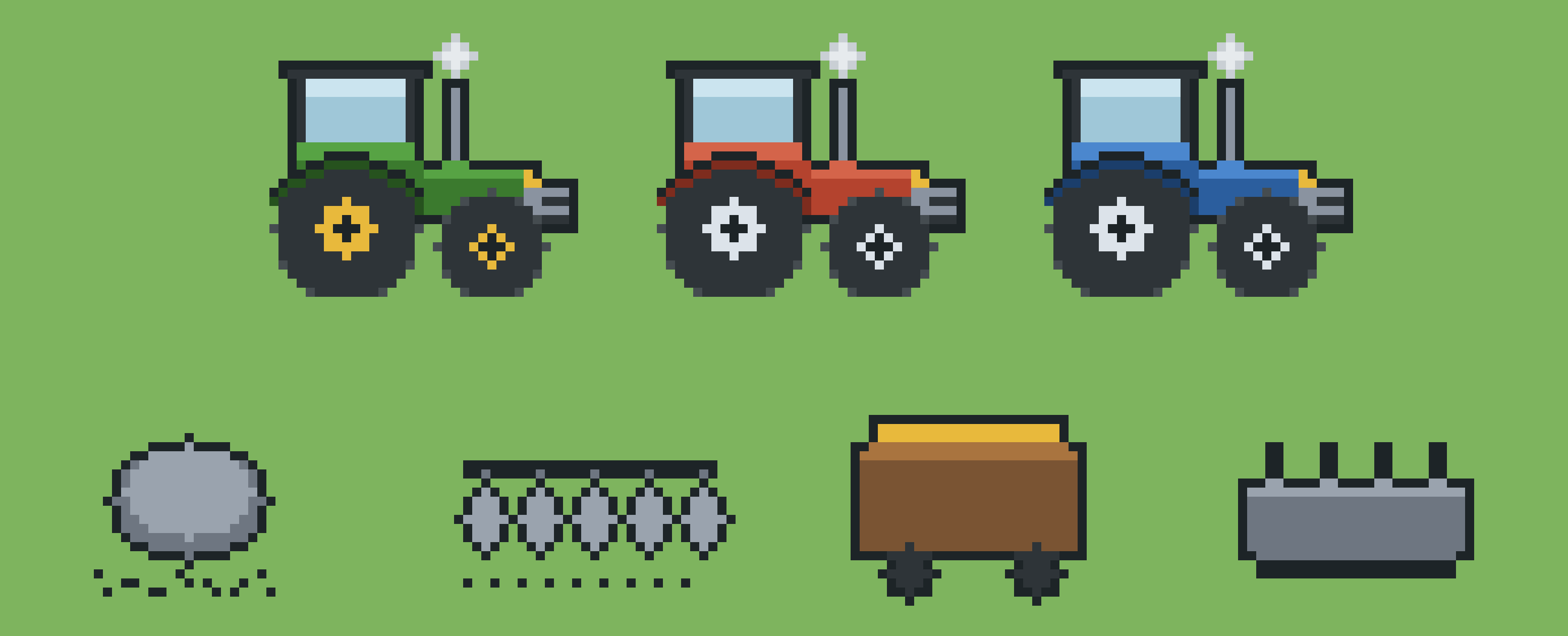
Four implements, four real jobs
Fertilise makes a field yield more. Harrow prepares the ground. Haul collects. And harvest drives over every crop and brings it all in at once — which is the difference between tending a vegetable patch and running a farm.
Each is a separate purchase, and none is required. You can play the whole village without a tractor; it is what happens when the farm outgrew your hands.
The hard part was not the journey
It was the draw order.
A top-down map has one simple, unforgiving rule: whoever is further south draws last and covers whoever is north. It is what makes the pet walk behind the barn and in front of the fence without anyone thinking about it.
The tractor had to join that queue. While it was drawn on top of everything — the easy path — it drove through walls. Now buildings, animals, the pet and the tractor all compete in the same depth ordering, every frame.
It is more work than it sounds, and it is what separates "a sprite that moves" from "a resident of the village".
The windmill: the farm becomes a chain
This is the change I am proudest of, and the least visible of them all.
An observation first. Looking at one of our players' saves, I found 19,958 units of corn in a warehouse capped at 19,982. He was not playing wrong — he was playing very well, for a very long time.
But it says something about designing game economies that goes beyond Tame: a farm made only of producers runs in one direction. You harvest, the number goes up, and it goes up until the cap. From there on, harvesting is a gesture without consequence.
The windmill is the answer. It takes corn and returns flour, which is what the big animals eat — horse, Highland cow, the expensive ones. With it, planting stops being "make the number go up" and becomes the first step of a chain:
plant → mill → raise
Three steps that depend on each other, instead of five independent taps dripping into the same bucket. It is very little code, it appears in no screenshot, and it is the reason the farm makes sense from here on.
The greenhouse: a choice with consequences
The greenhouse makes one crop yield more across the whole village. You pick which.
One choice per greenhouse, and it sticks. That is the kind of decision I like handing to a player: cheap to understand, expensive to change your mind about, and it reshapes the farm rather than just the number.
A sixteen-pixel detail: the first version of that screen showed only each crop's drawing. At that size, a carrot plant and a strawberry plant are two green smudges with a coloured dot. The name already existed — in the accessibility label, for screen readers. People reading with a finger knew what they were choosing; people reading with their eyes did not. Now it shows for both.
Crops keep time now
Tame has always had a golden rule: your pet saturates at 36 hours. Disappear for a week and it is in the same state as someone away for a day and a half. Coming back is never coming back to damage.
The farm got a rhythm of its own, and it is deliberately different. A field ripens and waits 24 hours. After that, unharvested, it dries out: the drawing withers, the stored yield resets, and one tap clears it and starts over.
The pet's rule stays untouched — the crop dries, the animal does not. What changes is that the farm now has a reason for you to show up today rather than next week. A farming game where nothing keeps time is not quite a farming game.
And the dried sprite looks good, which is not a technical argument, but it counts.
Every patch is its own patch
Another small change that changes the feel: each bed has its own marker. Tap it and you harvest that one, without touching its neighbours. The harvested bed goes back to seedling while the others stay ripe.
It sounds obvious written down. It is the kind of thing that only becomes obvious once it is done.
What a player taught us about buttons
A blind player, a Tamagotchi fan since the nineties, wrote to us describing in detail how the app behaved with VoiceOver on.
His report turned into direct work in this version:
- The meters announce values. "Hunger, 80%" — and the number now shows on screen too, which equally helps people with low vision.
- Every button has a label. None is discovered by pressing it to find out what it does.
- Lists are navigated item by item, with the price inside the label itself: you hear "Cake, 12 coins" instead of hunting for the cost elsewhere.
And an automated check joined our process: a new unlabelled button fails the build before it reaches anyone. That is the part that interests me most — accessibility that depends on remembering is accessibility that gets lost in the next version.
The Village is the next step on that front. It is drawn as a single graphics canvas, which calls for a layer of labelled targets over the map. It is queued, with a test reader on the outside that I would not have had otherwise.
The rest
Horse, goat, rabbit, fox and the Highland cow found their voices — tap and they answer. A rubber duck swims in the tub during bath time. Pets that have gone are kept in an album, with name, species and how long they lived. And text size became a setting, for anyone who prefers bigger type.
The farm has machinery now. Roads come next.