When Tame Village launched it was an honest skeleton: eight kinds of piece, three buildings that produced something, a fence, a gate and a vegetable patch. You could see the idea. You could not live in it.
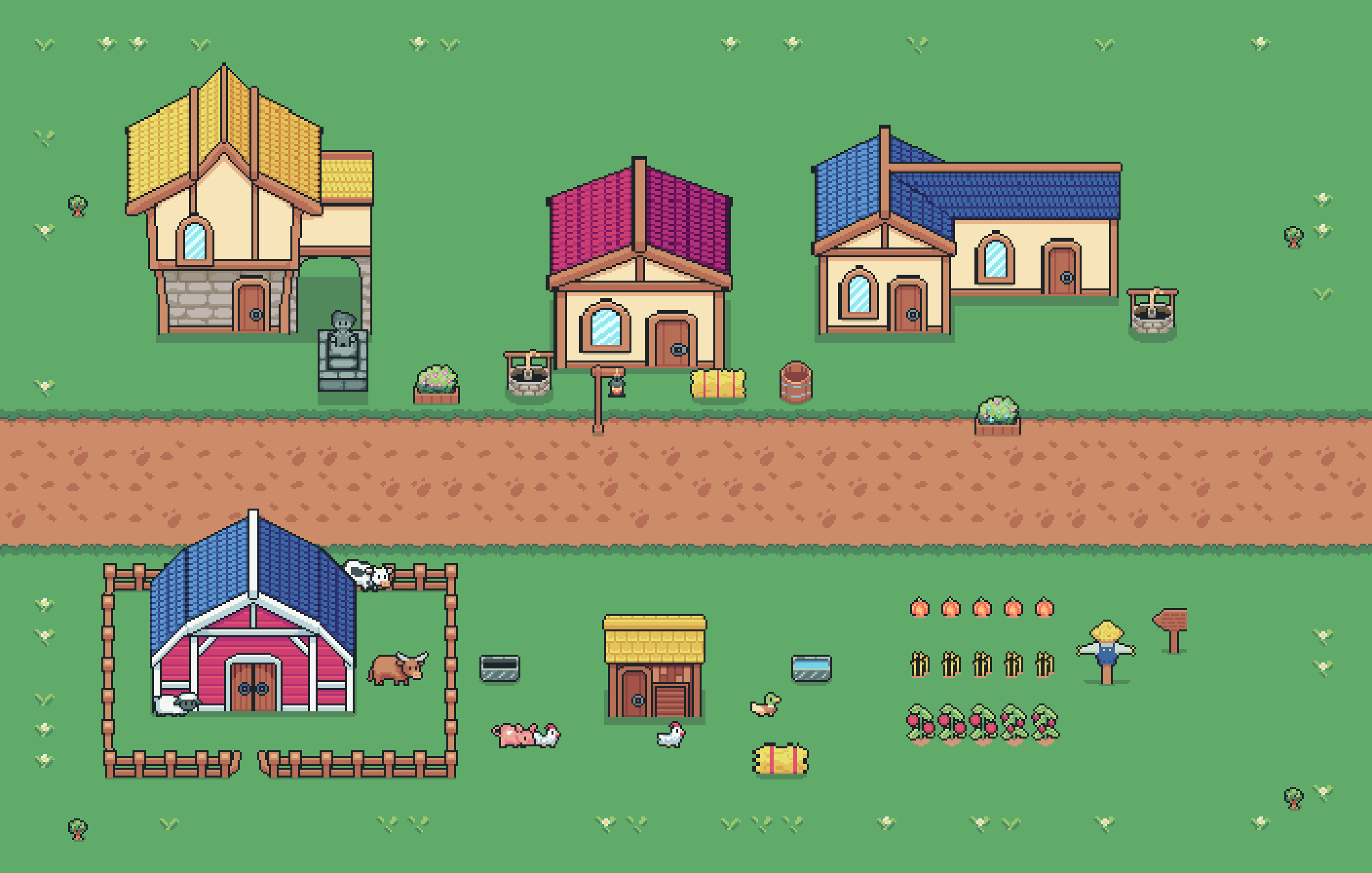
Now there are thirty. A cattle pen with cows and milk, six pets, five crops, ten decorations, doors and windows on the buildings, and an avenue that crosses your land and leaves the map.
The animal that produces nothing
The six pets — chicken, duck, pig, cow, bull and sheep — give no milk, no meat, no wool. They eat corn and wander around your land.
The first version of their description said exactly that: "produces nothing". True, and terrible. Nobody buys a 200-corn animal after reading that it is useless — and worse, the sentence hid the one reason to buy one.
Because the animal gains value. One gem every two days, up to a cap of twenty. Forty days to mature, on purpose: any faster and it would become a gem tap, and gems are the currency of land — a buy-wait-sell loop would break the whole progression.
It is the first thing in the Village that rewards patience instead of activity. Everything else asks you to come back, harvest, plant again. The animal asks you to keep it. And the cap is not the purchase price: you get the appreciation, not what you paid — refunding the corn would turn the purchase into a risk-free loan.
A road that leads nowhere, yet
The old layout wrapped every block in a ring of road. It looked organised and it cost a fortune: a fifth of the land became pavement nobody could use. Worse than that — a closed ring points nowhere.
Now the blocks touch each other and there is a single avenue, running between the two rows and carrying on east to the edge of the map. At its tip there is a sign with a green arrow. Tap it and you read that the road leads out into the wider world, and that pleasant visitors may arrive by it.
On the other side, along the western border, there is a river. And going west the avenue dies at its bank — not at the edge of your land. That difference is small in code and large on screen: a road that stops in the middle of a field reads as an unfinished map; one that dies at the water reads as a crossing that is missing.
Both ends make the same promise from opposite sides, and neither of them lies: the bridge and the world beyond do not exist yet.
The map grew and nearly took your farm with it
Here is the part nobody sees, and it nearly went wrong.
The pieces you build store their position in absolute map tiles. When the layout changed — blocks grew from 16 to 20 tiles and the ring of roads became an avenue — every plot moved a few tiles. Every piece of every farm already built started pointing at the wrong place.
On the device that is fixable with a migration, and we wrote one. But the cloud backup goes through no migration at all. A backup written in the old layout and restored into the new one would hand back a farm shifted sideways — or, if we bumped the format version to invalidate it, would hand back no farm at all.
The way out was to stop storing the absolute position. Today a piece is saved relative to its plot: which piece of land it sits on, and where in it. In memory it stays absolute, which is how the drawing and the pet's pathfinding use it; the conversion happens on save and on load.
The gain is not only for today. With relative positions and plot names anchored to the starting land, the map can grow in any direction — across the river, north, south — with no migration and without invalidating a single backup. The test that guarantees it writes into a four-plot town and reads it back in a six-plot one with a new column to the west, then checks the piece landed on the same plot, in the same corner.
Tasks, and a crown nobody can buy
There is also a list of Tasks now: build the town hall, put up twenty fence tiles, log in seven days. Each pays a real reward in resources and gems, and tells you on screen the moment you complete it — not the next time you open the list.
And the wardrobe gained nine accessories: sunglasses, round shades, reading glasses, a wizard hat, bows, white gloves and a bandana. Plus six paintings for the bedroom wall, including a portrait of your own pet.
The tenth item is not for sale. The crown shows up only for players who unlock every achievement — because an item you can buy says nothing about the person wearing it.