Tame already had one mini-game: Treat Catch, twenty seconds of reflexes tapping falling snacks. Now it has two. The second one is Snake — the one from the green-screen phone everybody played under the desk.
Why Snake
Picking a second mini-game is not picking the most fun game. It is picking the one a player recognises in one second. Snake has an advantage no new game could have: nobody needs a tutorial. You see the grid, you see the snake, and you already know what to do — and you already know you are going to die on a wall thinking you had room.
The wall kills
There are two Snakes in the world: the one that lets you cross the wall and come out the other side, and the one that kills on contact. We kept the one that kills. The wrapping version is kinder and duller: it removes the only source of tension the game has. The arena is 12 by 12, and it needs to be a cage.
Eating does not pay
This was the decision that moved the rest of the game the most, and the least obvious one.
The natural path would be one coin per fruit eaten. But Tame already had a coin faucet tuned around Treat Catch, and a second game paying per food would double that faucet overnight — which wrecks the whole economy, from shop prices to the point of the subscription.
So Snake pays by milestones: 5, 12, 22 and 35 points, capped at 11 coins a round. That changes what the game asks of you. Paying per fruit rewards safe little loops in the middle of the screen; paying per milestone rewards getting far — which is exactly what makes Snake tense. And both mini-games share the same daily allowance: three on the free plan, ten on premium. New game, same faucet.
The turtle that gets in the way to help
There is a bonus that shows up in the arena and slows the snake down. It does not score and does not grow you: it buys time.
The catch is that it only appears from 6 points on. Before that the snake is still slow, and slowing down would be a punishment dressed as a prize — you would grab it on reflex and end up worse. A bonus that only makes sense after a certain point should only exist after that point.
A block does not read as a snake
The most stubborn part was the drawing.
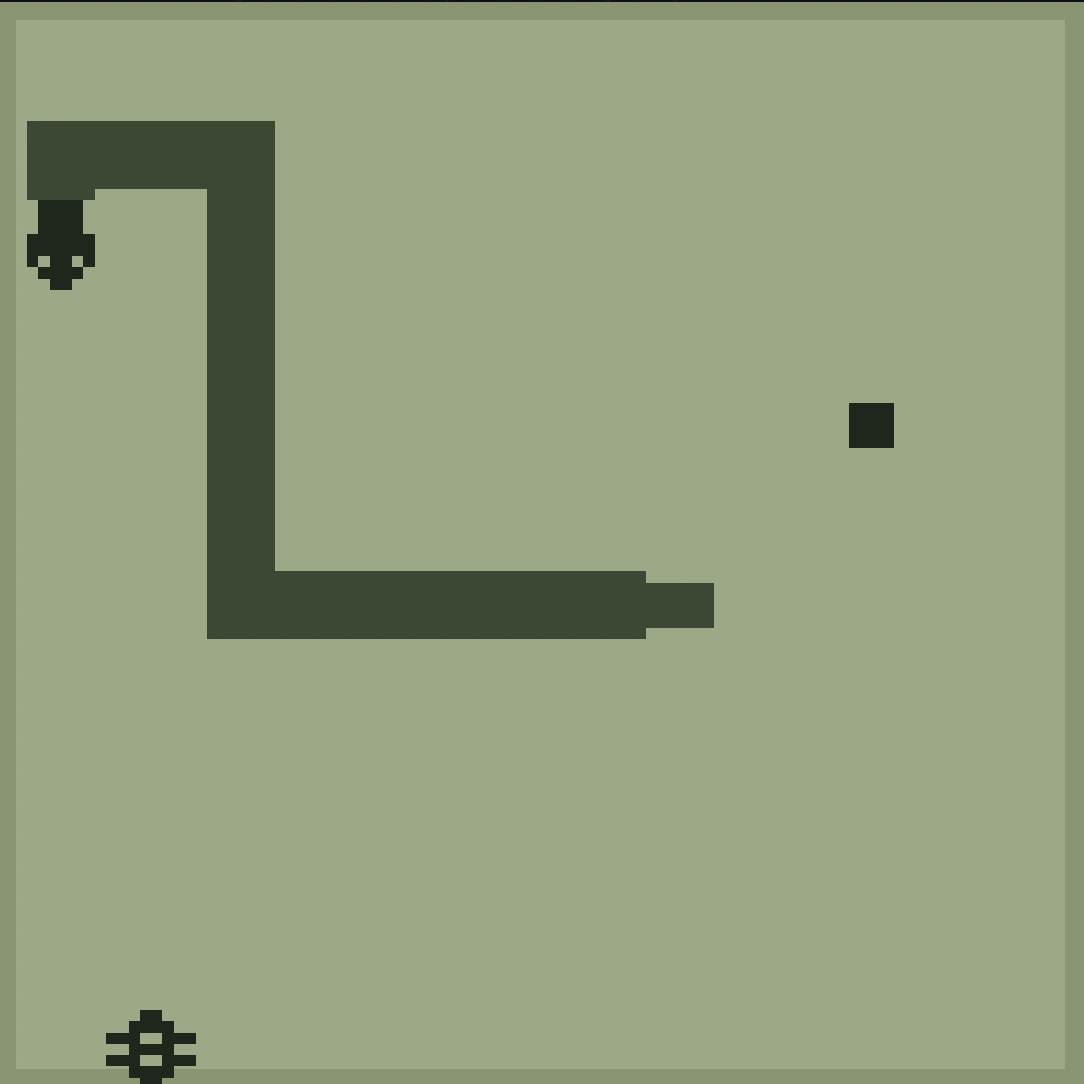
The head was already made of real pixels: an 8 by 8 sub-grid inside the cell, with a narrow snout, a wide skull and eyes cut out in the screen colour, rotating with the direction — one drawing, four headings. But the body stayed what it was at the start: a solid square filling the whole cell. The result was a nice head pulling a little train of squares.
Now the body speaks the same language as the head. It is a band 6 of the 8 sub-pixels wide — narrower than the cell, on purpose — with stubs pointing at each neighbour, which is what closes the corner without leaving a hole. And the tail tapers to 4, the same taper as the snout, at the other end.
We lost something there, and it is worth recording: the one-pixel gap between blocks is gone, and with it a little of that LCD "cells" reading. That was the price of the snake going from a queue of squares to a body.
Snake is in the Play menu, next to Treat Catch. Good luck with the wall.